

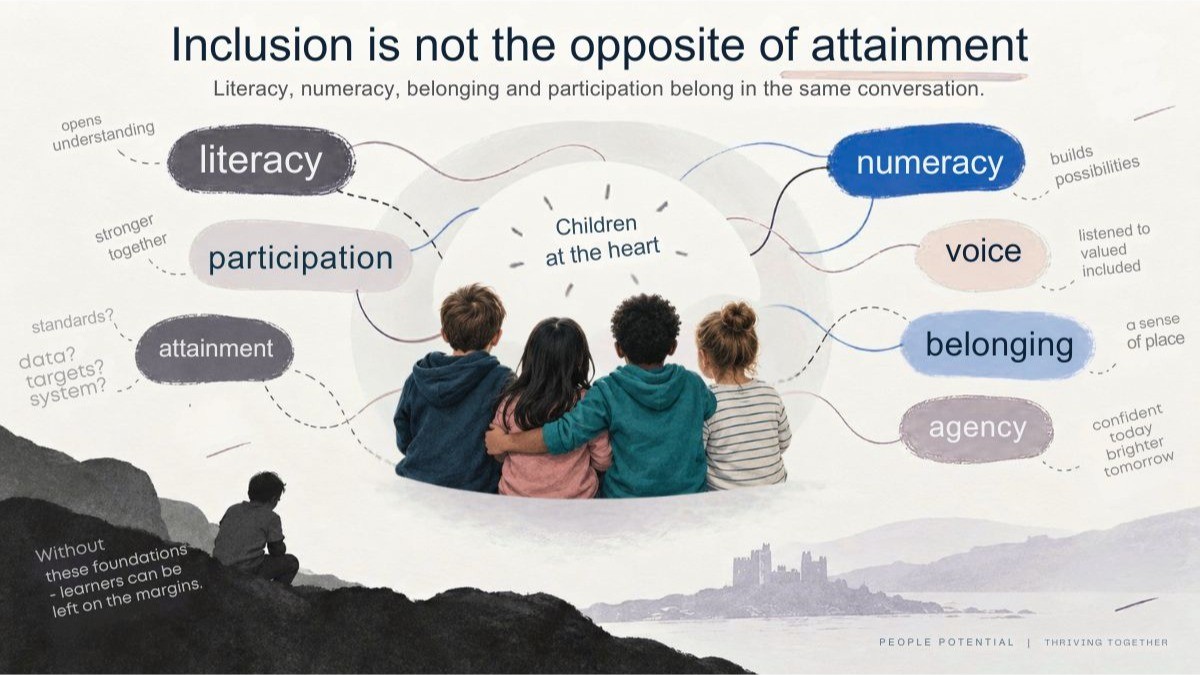
Why literacy, numeracy, belonging, participation and agency belong in the same conversation
As we enter National Inclusion Week, I’ve been reflecting on what we really mean when we talk about inclusion in education.
We often talk about standards and attainment in one conversation, and inclusion, belonging, learner voice and wellbeing in another.
Almost as though we have to choose.
I don’t think we do.
In fact, I increasingly think separating these things creates a problem.
For me, inclusion is about children and young people being able to access, participate, belong, make progress and have increasing agency over their lives.
A child cannot be fully included in education if they are physically present but unable to access the learning.
If we fail to secure strong literacy and numeracy foundations for children, we risk limiting their access, participation, confidence and future choices.
Literacy and numeracy are not separate from inclusion. They are part of the foundations that enable children and young people to participate, communicate, make choices and exercise agency.
What is the data telling us in Wales?
Wales has an ambitious vision for education through Curriculum for Wales. But alongside that ambition, the latest evidence is asking us to look carefully at how learners are actually doing — particularly in literacy and numeracy.
The Welsh Government’s national analysis of personalised assessments, published in June 2026, presents a mixed picture.
There are positives. English and Welsh reading showed significant recovery in 2024–25, with English reading attainment for Years 3 to 9 reaching its highest level since these assessments began.
Numeracy, however, presents a more challenging picture. Procedural numeracy remains below pre-pandemic levels, with different patterns of progress across age groups.
But averages only tell us part of the story.
What really matters is who is doing well — and who is being left behind.
The same Welsh Government data shows substantial differences between learners eligible for free school meals and their peers. By Year 6, the reported gaps were equivalent to around 23 months in procedural numeracy, 26 months in English reading, 31 months in Welsh reading and 28 months in numeracy reasoning. The gaps generally become larger as learners move through the school system.
These are not just numbers about attainment. They are about access and opportunity.
And these gaps should trouble us.
They represent children moving through education with very different levels of access to learning and, ultimately, very different opportunities for their futures.
We cannot normalise that. And we cannot allow disadvantage to become destiny.
If children move through education without secure foundations in literacy and numeracy, we risk limiting their ability to access learning, participate confidently, express themselves, make choices and prepare for adulthood.
That makes literacy and numeracy an inclusion issue too.
And now we have the latest PISA results
We also have brand-new international evidence.
PISA 2025 was published on 8 September 2026. So while we might think of these as the new “2026 PISA results”, the assessment cycle itself is PISA 2025.
The picture for Wales again needs some nuance.
Science was broadly stable compared with 2022. Reading was also not statistically different from 2022, although it remains below the level recorded in 2018. Mathematics fell further, from 466 points in 2022 to 456 in 2025.
But there is another statistic that I think deserves much more attention.
In Wales, 31% of learners were below PISA’s baseline proficiency level in reading, 36% in mathematics and 27% in science. PISA describes Level 2 as an important baseline for the knowledge and skills needed for participation in society.
That takes this conversation beyond league tables.
Because literacy and numeracy are not simply about examination results.
They shape whether a young person can participate confidently in education, employment and adult life.
When more than a quarter of learners are below the baseline proficiency level across these areas, this cannot simply be treated as an attainment problem.
It is an inclusion problem too.
For me, this is where attainment and inclusion become impossible to separate.
Literacy gives you a voice
When we talk about learner voice, we often think about asking young people what they think.
But meaningful voice requires access.
Being able to read, understand information, communicate ideas, make choices, ask questions, challenge decisions, complete forms, use digital systems and understand what is happening around you all influence how much agency you really have.
The same applies to numeracy.
Understanding money, wages, bills, time, travel, measurements, medication instructions, data and risk all matter in adult life.
So I don’t see literacy and numeracy as somehow sitting in opposition to broader ideas such as confidence, belonging and wellbeing.
Quite the opposite.
They can help make those things possible.
Belonging is also about being enabled to succeed
Belonging is sometimes described as primarily an emotional experience: feeling welcomed, accepted and valued.
Of course it is.
But I think there is another dimension.
Imagine repeatedly being in an environment where you cannot access the text, follow the instructions, record your ideas, organise what is expected of you or demonstrate what you know.
You may physically be included in the classroom.
But do you experience yourself as a successful member of that learning community?
Over time, repeated experiences of difficulty can shape confidence, identity and expectations.
That is why genuine inclusion cannot simply mean placing learners in the same space and hoping they manage.
We have to ask whether the teaching, environment, technology, relationships and support actually enable them to participate.
Sometimes that will involve explicit literacy or numeracy teaching. Sometimes it will involve assistive technology. Sometimes scaffolding, changes to teaching, communication support, additional processing time or different ways of demonstrating learning.
Usually it will involve several of these things together.
The aim should not be to make learning easier by lowering expectations.
It should be to remove unnecessary barriers while strengthening the learner’s capacity to succeed.
Equity means looking beyond averages
This is where the work of ADR Wales becomes particularly interesting.
Its current education research programme includes examining the impact of Curriculum for Wales on learners’ experiences and outcomes, alongside work on socioeconomic disadvantage, attendance and Additional Learning Needs reform.
For me, that leads to one of the most important questions we can ask about any educational reform:
Who is benefiting?
Not simply: has the policy been implemented?
Not simply: are schools following the guidance?
And not even simply: has the national average improved?
Who is participating?
Who is progressing?
Whose barriers are being reduced?
Who feels successful?
Who is acquiring the knowledge and skills they need for adulthood?
And who is still being left behind?
Interestingly, the latest PISA evidence also gives Wales something important to build on. Although disadvantaged learners still achieve lower scores, the relationship between socioeconomic background and attainment was weaker in Wales than across the OECD on average. That matters. It tells us that the story is not simply one of failure. There are strengths within the Welsh system alongside very real challenges.
We shouldn’t have to choose
I sometimes worry that education debates push us towards two camps.
One talks about standards, knowledge, literacy, numeracy and attainment.
The other talks about wellbeing, inclusion, relationships, belonging and learner voice.
Children need us to stop treating these as opposites.
A young person needs to feel safe enough to learn.
They need relationships which communicate that they are valued.
They need adults who understand the barriers they experience.
They need appropriate adjustments and support.
They need opportunities to participate.
But they also need us to teach them.
They need literacy.
They need numeracy.
They need knowledge.
They need opportunities to experience success and develop independence.
And ultimately they need an education that prepares them to participate in the world beyond school.
For me, that is what equity is about.
Not lowering the bar in the name of inclusion, but making sure that all learners have a meaningful opportunity to reach it.
As Wales continues to develop Curriculum for Wales and strengthens its approach to literacy, numeracy and national monitoring, the question cannot simply be whether attainment is improving.
We also have to ask whether all learners are being given what they need to participate, belong, progress and prepare for adulthood.
Because being seen, being heard and belonging matter.
But so does having the literacy, numeracy, knowledge and support that allow you to use your voice, make choices and shape your own future.
And the evidence tells us that we still have a lot of work to do.
We cannot be comfortable with children moving through education without the foundations they need to navigate adult life.
We cannot accept widening gaps as inevitable.
And we cannot call an education system inclusive if significant numbers of learners are still being left at the margins of learning and opportunity.
Inclusion must mean more than being present. It must mean having the opportunity, support and foundations to participate, succeed and build a future.
We cannot leave children behind and still call that inclusion.
References and further reading
- Welsh Government (2026), Patterns in reading and numeracy attainment: September 2018 to August 2025, published 25 June 2026. Read the Welsh Government report
- Welsh Government (2026), PISA 2025: National Report for Wales, published 8 September 2026. Read the PISA 2025 Wales report
- Welsh Government (2023), PISA 2022: National Report for Wales, useful for comparison with the latest cycle. Read the PISA 2022 Wales report
- ADR Wales, Education Research Programme, including work on curriculum change, socioeconomic disadvantage, ALN reform, attendance and learner outcomes. Explore ADR Wales education research
- Welsh Government (2026), New national indicators to monitor progress in literacy and numeracy, setting out the developing national approach to tracking progress. Read about the new literacy and numeracy indicators